Tales From Qabristan (2024)


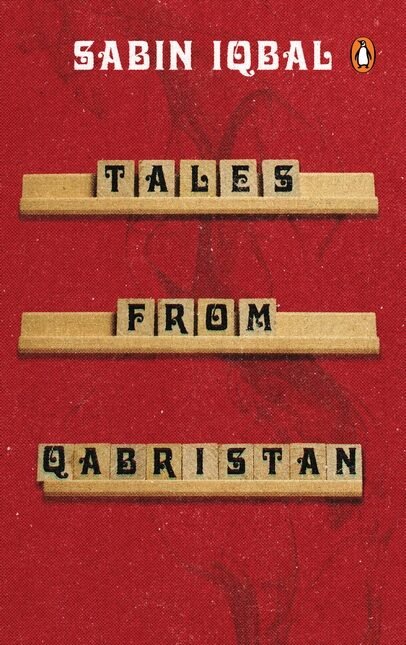
Tales from Qabristan (2024) represents Iqbal’s most recent work, centring on a young protagonist named Farook who must deal with his father’s death from lung cancer. At its core, the novel is a meditation on memory, grief and the inescapable weight of familial and social legacies, as Farook returns to his childhood village after his father’s death and must come to terms with the shifting contours of home, identity and belonging. The book is described as a strikingly vivid portrayal of a boy trying to understand the world through the eyes of adults around him as he navigates failure, love, life and death, with language that often slips into magical realism, traversing the realms of both fantasy and reality. The novel treats graveyards not as mere resting places but as vast archives where memory, mystery, and revelation intersect.
PRAISES FOR TALES FROM QABRISTAN
Sabin’s novel is a striking work of diasporic literature—raw, reflective, and unapologetic, blending social fiction, autofiction, and stark realism. His atypical storytelling refuses the comfort of continuity, echoing the dislocations and fractures of exile and displacement. Memory and myth collide, not as distant echoes, but as urgent presences shaping lives caught between worlds. This is literature forged in the aftermath of departures, where identity is a question without easy answers, and every grave is a contested space, holding stories that refuse to be silenced, demanding to be unearthed and spoken into existence.
—Eurasia Review
Tales From Qabristan’s strength lies in the way it pieces together fragments of memory, allowing the lives it recounts to remain messy, unresolved, and real, and I think that is what makes it a memorable and worthy read.
—The Scroll
At its core, the novel is a meditation on memory, grief and the inescapable weight of familial and social legacies. The protagonist, Farook, returning to his childhood village after his father’s death, must come to terms with the shifting contours of home, identity and belonging. The fragmented narrative interlaces past and present, tracing intergenerational trauma through a multitude of characters. History permeates personal struggles that shape the village, reinforcing the cyclic nature of ambition, exile and nostalgia.
—The Wire
At one level, Tales from Qabristan is a lurid and dispassionate telling of the tale of a Muslim boy trying to come to terms with himself and his different identities. It is the never-ending story of the ethos of manhood, figuratively circumcised and curled up in a toxically patriarchal and hostile world. On passing, the camouflaged threshold, it reveals itself as a magnificent historical dome of the Qatar of hopes and setbacks of people, where every effort to raise voices echoes within the never-ending cries of the dead—not only humans but things and emotions, desire and dreams. It renders the sight of a house glowing not with love but with a sad acceptance of its perennial ill-fate. Sabin Iqbal is a magician of a storyteller.
—KR Meera, award-winning Malayalam novelist
A living, tropical novel where the soil and the senses discover a new language.
—Sumana Roy, poet and writer